One Day in Salzburg
A realistic, walkable one-day route through Salzburg — the Old Town squares, the fortress, a Mozart sight, Getreidegasse and Mirabell at golden hour — paced so you actually enjoy it rather than sprint.

Photo: Free Walking Tour Salzburg / Unsplash · Unsplash License
- ✓Everything in this plan is walkable; the only ride is the fortress funicular, and even that is optional.
- ✓Start on the left bank with the Domplatz–Residenzplatz–Mozartplatz triangle, the ceremonial heart of the city.
- ✓Climb to Hohensalzburg around late morning for the definitive panorama before the midday crowds peak.
- ✓Save Mirabell Gardens for the soft light of early evening — free, open and at its loveliest then.
- ✓One day is enough for the essentials if you go slow on fewer things rather than racing the whole list.
What one day in Salzburg can realistically be
A single day in Salzburg is genuinely enough to fall for the place, provided you resist the urge to see everything. The Old Town is tiny and intact — a Baroque amphitheatre of squares and domes under a fortress that was besieged but never taken — and almost all of it sits inside one loop of the Salzach. That means a good one-day plan is less about logistics than about restraint: pick the headline cluster, climb the fortress once, taste a Mozart sight, and leave the gardens for the golden hour.
The route below runs the left-bank squares and the fortress in the morning, Getreidegasse and a coffeehouse break around lunch, and the right-bank gardens in the late afternoon, ending by the river. It is paced for a real human, not a checklist machine. Treat the opening hours and ticket prices as things to confirm on the day — verify locally rather than trust a fixed timetable — and lean on the Old Town walk for the turn-by-turn detail between stops.
Morning — the left-bank stage
Begin at Domplatz, the great square under the cathedral, where the white marble facade and the Marian column set the tone for the whole day. Step inside Salzburg Cathedral — this is where Mozart was baptised and later worked as court organist — then drift through to Residenzplatz, dominated by the giant Residenzbrunnen, the largest Baroque fountain north of the Alps. Round the corner to Mozartplatz for the composer's statue, and you have walked the ceremonial triangle of the left bank in under half an hour.
From here, dip into St Peter's: the abbey church, the rock-cut catacombs and the romantic cemetery tucked against the Mönchsberg cliff are among the most atmospheric corners in the city, and the adjoining bakery has been turning out bread from a wood-fired oven for centuries. If you want a museum-grade morning instead, the DomQuartier links the cathedral, the Residenz state rooms and a terrace walk in one ticketed loop. Either way, you are now perfectly placed for the climb.
- Domplatz and the Cathedral — Mozart's baptism church; free to enter, donations welcome.
- Residenzplatz and the Residenzbrunnen — the Baroque fountain and the city's grandest open square.
- Mozartplatz — the statue and a good orientation point.
- St Peter's Abbey, cemetery and catacombs — atmospheric and largely free; the bakery is a fine stop.


Late morning — up to the fortress
Hohensalzburg is the one sight almost everyone climbs, and for good reason: begun in 1077 and never taken by force, it is one of the largest fully preserved castles in Central Europe, and its ramparts give the definitive panorama over the domes, the river and the Untersberg beyond. Ride the Festungsbahn funicular up from Festungsgasse for the easy way, or take the steep cobbled walk if your knees are willing — going up by rail and walking down is the classic compromise.
Inside, the state rooms, the fortress museums and the Reckturm viewpoint reward an hour or so. If you bought a Salzburg Card, check whether your funicular ride and admission are already included before paying separately. Time your visit for late morning, before the midday peak, so the ramparts aren't shoulder-to-shoulder when you reach the best view. Then come back down hungry, because lunch and Getreidegasse are waiting at the foot of the hill.
- Festungsbahn funicular up from Festungsgasse; the walk up is free but steep.
- Allow about an hour inside for the state rooms, museums and the Reckturm panorama.
- Check Salzburg Card inclusion before buying a separate funicular or admission ticket — verify current terms.
- Late morning beats the midday crush at the best viewpoints.

Midday — Getreidegasse, Mozart and a coffeehouse
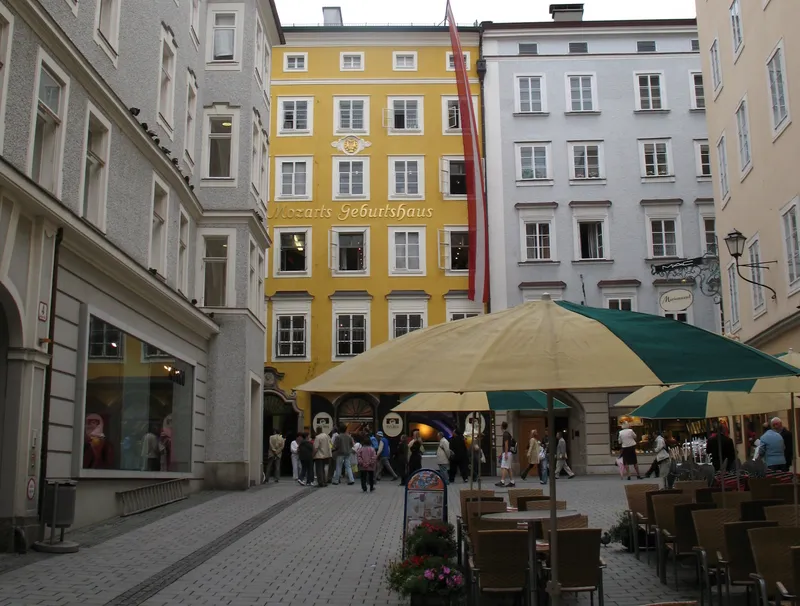
Back at street level, walk the length of Getreidegasse, the medieval canyon of wrought-iron guild signs that is Salzburg's most famous lane. Even the modern chains hang their names in hand-forged iron here, and the hidden courtyards (the Durchhäuser passages) reward a curious detour. At No. 9, the bright yellow house is Mozart's Birthplace, a museum since 1880; even a short visit to the rooms where he was born in 1756 puts the city's musical obsession in context.
Then do the most Salzburg thing of all and sit down for coffee and cake. The historic coffeehouses serve their cake under chandeliers with no rush to move you on, and a slice of Sachertorte or a shared Salzburger Nockerl — the mountain-shaped soufflé meant to mimic the city's hills — is a fitting midday pause. This is the moment to slow the day deliberately, because the afternoon is lighter on its feet.


Late afternoon and evening — Mirabell and the river
Cross the Salzach by the Makartsteg, the love-lock pedestrian bridge that frames the fortress for the classic river photo, and you are on the right bank near Mirabell. Save the gardens for now precisely because they are at their best in the late-afternoon and early-evening light: the formal Baroque parterre lines up on its central axis to point straight at the fortress, the Pegasus Fountain catches the low sun, and the terraced steps will be familiar to anyone who knows 'Do-Re-Mi'. Mirabell is free and open, so this is a beautiful, no-ticket finale.
From there, a slow walk back along the river makes the natural end to the day, with the fortress lighting up as dusk settles. If you have the energy for one more thing, an evening fortress or Mirabell concert turns a sightseeing day into something more memorable, and many beer halls and cellars serve late if dinner calls instead. Either way, you will have seen the essence of Salzburg in a day — and probably resolved to come back for a second.


Arriving for the day — layovers, day trips and cruises
Many one-day visitors are not staying overnight at all: they arrive by train from Vienna, Munich or Innsbruck, by coach on a tour, by river cruise mooring at the city's quay, or on a layover between flights. The good news is that Salzburg is unusually kind to a day visit, because the centre is so compact and so close to its arrival points. From the main station, Salzburg Hauptbahnhof, it is a flat fifteen-to-twenty-minute walk or a short bus ride down to Mirabell and the river — meaning you can drop your bag and be on the route within half an hour of stepping off the train. The airport is similarly close on the west side.
If you have luggage, use one of the lockers or left-luggage facilities at the station so you can walk the Old Town unencumbered; our luggage-storage notes cover the options. Trains from Munich (around an hour and a half) and Vienna (around two and a half hours) make Salzburg an easy day trip in either direction, and the high frequency means you can pick a late return and still get a full day. River-cruise and coach passengers usually have the tightest windows, so for them the morning left-bank cluster plus the fortress is the priority, with Getreidegasse and a quick Mirabell loop if time allows. Whatever your arrival, confirm your return time first and build the day backwards from it.


Eating well on a single day
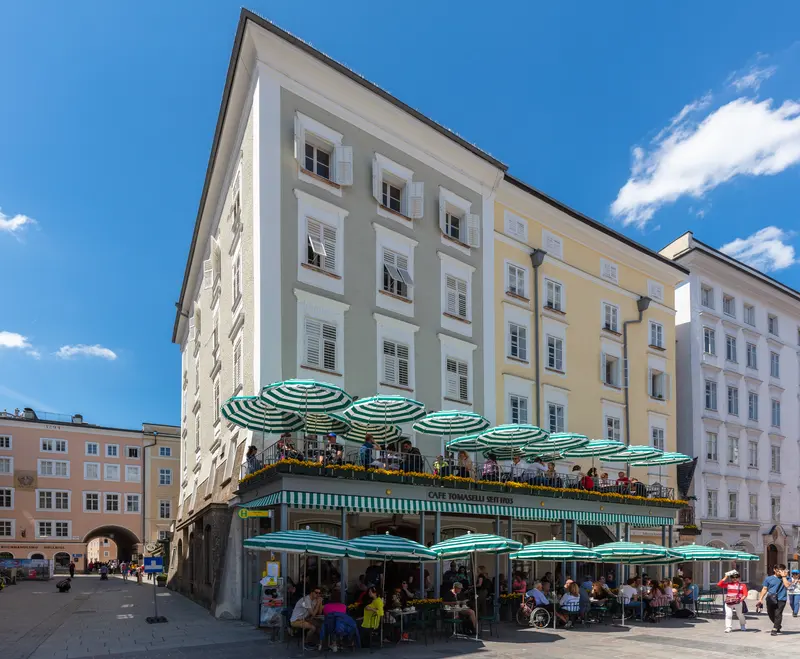
With only a day, your meals double as experiences, so choose them with the same care as the sights. For a quick, atmospheric lunch close to the morning cluster, the Grünmarkt stalls on Universitätsplatz behind Getreidegasse sell sausages, cheese, bread and snacks to eat on the hoof, while the cellars of the Old Town offer a sit-down plate of schnitzel or roast pork without a long detour. The midday coffeehouse stop is the one fixed ritual worth protecting: Café Tomaselli on Alter Markt, trading since the early eighteenth century, is the classic — a Melange, a slice of cake from the tray, and a deliberate pause in the middle of the day.
Try the local specialities while you can. A Salzburger Nockerl, the soufflé built into three peaks to mimic the city's hills, is best shared because it is enormous, and a genuine Original Mozartkugel from Fürst — the confectioner that created it in 1890 — makes the ideal one-day souvenir to eat on the spot or carry home. If your day stretches into the evening, end it the local way at a beer hall or cellar rather than a tourist-strip restaurant; the Augustiner Bräustübl in Mülln is the great Salzburg beer-hall experience, though it sits a little out from the centre, so weigh the walk against your remaining time.

Doing it well in any season
The one-day route holds up year-round, but the season changes its texture. In high summer the Salzburg Festival fills the squares from late July into August, and Domplatz may be closed off for the open-air Jedermann staging or a performance — a thrilling backdrop, but one that can reroute your morning, so check what's on. Long summer daylight is a gift to a day trip: Mirabell at golden hour can run well into the evening. Spring and autumn give the most comfortable walking weather and thinner crowds, with the hill woods turning gold in October.
Winter rewrites the afternoon. The Hellbrunn trick fountains close for the season, but from mid-November the Christkindlmarkt takes over Domplatz and Residenzplatz, and a one-day December plan can simply fold a market circuit — mulled wine, roast chestnuts, craft stalls under the floodlit cathedral — into the standard route, swapping the golden-hour garden for the glow of the market lights. Short daylight means an earlier start, and the cold and occasional ice make sturdy shoes and a warm layer essential. Whatever the month, confirm opening hours and any Festival or holiday closures before you set out, since a single closure can reshape a tightly packed day.


At a glance: running the day
A planning sketch, not a timetable. Confirm cathedral, fortress and museum opening hours, funicular operation and any Festival-season closures on the day — verify locally rather than rely on fixed times.
- Morning: Domplatz → Cathedral → Residenzplatz → Mozartplatz → St Peter's.
- Late morning: funicular up to Hohensalzburg; allow about an hour, then walk down.
- Midday: Getreidegasse and Mozart's Birthplace, then coffee and cake.
- Afternoon/evening: Makartsteg → Mirabell Gardens at golden hour → riverside walk.
- Cost: the squares, churches and gardens are free; the fortress, museums and any concert are the outlays — verify prices.
- Pace: a full but unhurried day on foot; trim by skipping the museum interiors if time is tight.


Related guides

Salzburg Itineraries
Ready-made Salzburg trip plans for one to four days, weekends, couples, families, music lovers, Festival-goers and Christmas-market visitors — each built outward from the river so you walk smart and never backtrack.
Read guide
Self-Guided Salzburg Old Town Walk
A step-by-step self-guided walking route linking Mirabell, the river views, Getreidegasse, the cathedral, St. Peter's and the climb to the fortress — done at an easy half-day pace.
Read guide
Hohensalzburg Fortress Guide
A practical guide to Hohensalzburg Fortress — tickets, the Festungsbahn funicular, the state rooms and museums, the best viewpoints, timing and Salzburg Card notes for the hilltop castle.
Read guideMore in Itineraries
6
A Weekend in Salzburg
A Friday-to-Sunday plan for Salzburg with hotel-area logic, concert timing, the best viewpoints, where to eat and a soft day-trip choice for Sunday.
Read guide
Four Days in Salzburg
A slower four-day Salzburg plan that adds museums, quieter neighbourhoods, a Sound of Music morning and two day-trip options to the classic city core — paced for travellers who want to live in the city rather than sprint through it.
Read guide
Luxury Salzburg Itinerary
A high-end three-day Salzburg plan built around grand hotels, private guides, fine dining, a chauffeured lake day and concert nights — the city at its most unhurried and elegant, with everything booked ahead.
Read guide
Mozart & Music Itinerary
A music-led day through Salzburg — both Mozart houses, the cathedral and abbey where he played, the Mozarteum and Marionette Theater, and an evening concert chosen by setting, not just programme.
Read guide
Salzburg Christmas Market Itinerary
A festive Salzburg plan for the Advent season — the Christkindlmarkt on the cathedral squares, smaller side markets, Advent music, warm coffeehouses, a candlelit Hellbrunn evening and the best floodlit viewpoints.
Read guide
Salzburg Festival Itinerary
How to build a trip around the Salzburg Festival — booking ahead, shaping the day around performances, balancing opera and drama with sightseeing, choosing meals and a hotel, and pacing in rest so the culture lasts.
Read guide