Getreidegasse Guide
Wrought-iron signs, shops, Mozart's Birthplace, hidden courtyards, cafés and how to walk Salzburg's most famous lane without the crush.

Photo: Jorge Franganillo / Wikimedia Commons · CC BY 2.0
- ✓Getreidegasse is the Old Town's medieval canyon of wrought-iron guild signs — a streetscape so cohesive that even McDonald's had to commission a hand-forged sign to fit in.
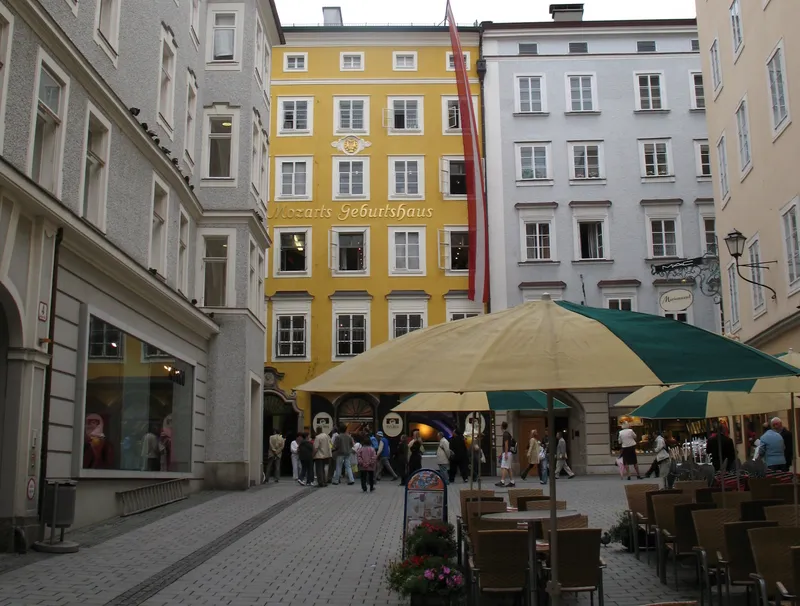
- ✓Mozart was born at No. 9 in 1756; the bright-yellow Hagenauer Haus is the most photographed façade in Salzburg.
- ✓The real magic is in the durchhäuser — the through-passages and courtyards that knit the lane to Universitätsplatz and the river.
- ✓It is a shopping street first and foremost, from traditional Trachten and Austrian crafts to global brands behind historic frontages.
- ✓Go early or late: between mid-morning and late afternoon in season the narrow lane fills wall to wall.
A street you read like a book of signs
Getreidegasse is the spine of Salzburg's left-bank Old Town: a long, narrow, tall-sided lane that runs roughly parallel to the Salzach, hemmed in by burghers' houses five and six storeys high. Look up and the whole street becomes legible. Before most people could read, shops announced their trade with a hanging sign — a pretzel for the baker, a key for the locksmith, a horse for the saddler — and Getreidegasse has kept that tradition alive as a living gallery of wrought iron. Many signs are genuinely old; others are modern businesses that, by local custom and conservation rules, commissioned a forged emblem to match. The result is one of the most complete medieval-to-Baroque commercial streetscapes in Central Europe.
The name itself is a small etymological trap. It sounds like Getreide, the German for grain, but most historians trace it instead to Trabgasse — a lane you 'trot' (traben) along — softened over centuries into Getreidegasse. Either way, the street has been Salzburg's main artery of trade for the better part of a millennium, and it still is: this is where the city shops, window-shops and meets, under a skyline of iron.
At a glance
Getreidegasse is free and open all day — it is a public street, not a ticketed sight. The detail below is evergreen; confirm individual shop and museum hours close to your visit.
- What it is: Salzburg's most famous shopping lane, in the heart of the UNESCO-listed Old Town.
- Where: left (south) bank of the Salzach, running from Rathausplatz at the east end toward Bürgerspitalplatz and the Blasiuskirche at the west.
- Headline sight on the street: Mozart's Birthplace, No. 9 (the yellow house).
- Cost: free to walk; shops, cafés and the Mozart museum charge separately.
- Best time: at opening (around 09:00) or in the evening after the shops close, when the iron signs photograph beautifully and the lane empties.
- Don't miss: the durchhäuser — covered passages cutting through the houses to courtyards and parallel squares.
- Accessibility: the lane is flat and cobbled; courtyards and shop entrances vary, and the street gets very tight when busy.
No. 9: Mozart's Birthplace and the yellow house
The single most visited address on the street is Getreidegasse 9, the Hagenauer Haus, where Wolfgang Amadeus Mozart was born on 27 January 1756. The Mozart family rented rooms on the third floor for some twenty-six years, and the house has been a museum since 1880. You will know it instantly: it is painted a confident egg-yolk yellow, hung with a banner, and almost always has a small knot of people photographing the façade from the middle of the lane.
Even if you don't go inside, the house anchors the whole street's identity — Getreidegasse is, for most visitors, 'the Mozart street'. If you do want to step in, treat the Birthplace as its own visit with its own timed rhythm rather than something to squeeze in between shops; the staircases are steep and the rooms small, so it rewards an unhurried hour.
The signs, and why they all match
The wrought-iron Aushängeschilder are the reason photographers love this lane. Each one is a small sculpture — gilded, scrolled, often topped with the shop's emblem and sometimes the year of a guild — projecting out over the street so it can be read from a distance and from both directions. Salzburg's strict conservation rules in the protected Old Town mean new tenants cannot simply bolt up a backlit logo; they commission a hand-forged sign in the historic idiom. That is why the most-told anecdote on the street is true: the international fast-food and fashion chains here trade behind discreet, period-correct iron, not glowing plastic.
Walk the lane once just looking up, then once looking into the doorways. The signs tell you what a building was as much as what it is now: pharmacies, bakers, goldsmiths, drapers, all announced in metal. It is the closest thing Salzburg has to a medieval shopping directory still hanging in place.
Through the houses: the durchhäuser and courtyards
If Getreidegasse only offered its façade it would still be worth the walk, but its secret is depth. The tall houses are pierced by durchhäuser — vaulted passageways that tunnel straight through a building from the lane to a hidden courtyard or out to the parallel Universitätsplatz and the riverside. Slip into one and the crowd noise drops away; you find arcaded yards, old wells, ivy, small workshops and the occasional café table where almost nobody else is standing.
Use these passages strategically. When the lane is shoulder-to-shoulder in high season, the durchhäuser are both an escape route and the best photographs of the day. They also connect you efficiently to the Grünmarkt on Universitätsplatz — the open-air produce and snack market in front of the Kollegienkirche — so you can leave the shopping street, buy a pretzel or a wedge of mountain cheese, and loop back without ever retracing your steps.
Shopping the lane
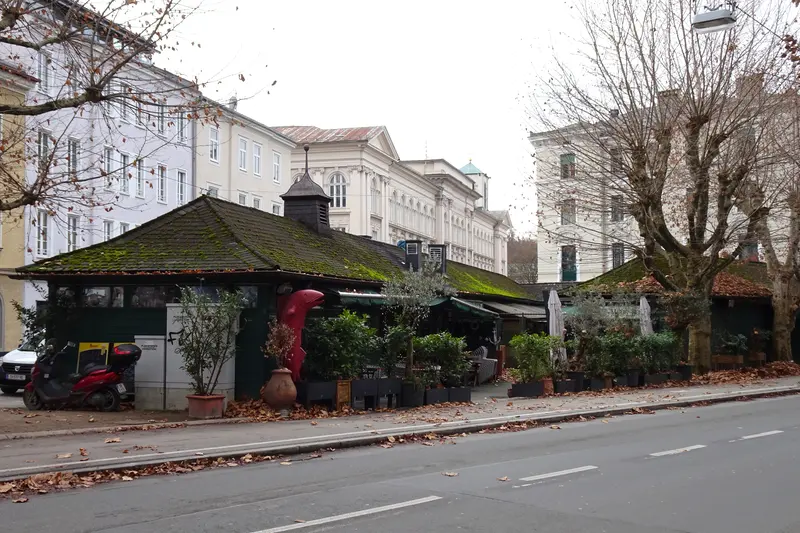
Getreidegasse has been a shopping street for centuries and remains one today, which is part of its charm and part of its trap. You'll find the full Salzburg spread: traditional Trachten houses selling dirndls and loden jackets, confectioners with Mozartkugeln stacked in the window, watchmakers and jewellers, Austrian crafts, perfumeries, plus the global luxury and high-street brands that cluster on any famous street — all, again, behind their forged signs.
For souvenirs with substance, look for the long-established local names rather than the airport-style gift shops: a proper confectioner for sweets, a Trachten house for something you'll actually wear, a stationer or bookseller for prints of the old city. The Birthplace museum shop is also a reliable stop for tasteful Mozart memorabilia. As ever in a tourist heart, prices on the lane itself run higher than a street or two back; the passages and side squares hide better value.
When to go, and how to walk it well
Getreidegasse is narrow, and in the warm months and during the Festival and Advent it fills completely between roughly mid-morning and the early evening. The lane is at its most photogenic — and most walkable — right at shop opening or after closing, when the cobbles, the signs and the lit windows have the street almost to themselves. Early light from the east end and the lamps after dusk are both kinder to the iron signs than flat midday glare.
A simple loop works best. Enter from Rathausplatz at the eastern end, walk the full length looking up, divert through one or two durchhäuser to the Grünmarkt and the river, then return along Universitätsplatz. Combine it with the cathedral squares and the climb to the fortress and you have the whole left-bank Old Town in a single unhurried morning.
Related guides
Mozart's Birthplace Guide
Tickets, rooms, exhibits, accessibility limits, Getreidegasse context and who should plan a visit to the house where Mozart was born.
Read guide
Salzburg Old Town Guide
How to explore Salzburg's UNESCO Old Town — the Baroque squares, the cathedral and churches, Getreidegasse's lanes, the hidden courtyards, viewpoints and riverside walks.
Read guide
Things to Do in Salzburg
The complete hub for what to do in Salzburg — the fortress, Mozart sights, Mirabell, the Old Town squares, Sound of Music stops, viewpoints and Alpine day trips, grouped so you never backtrack.
Read guideMore in Things to Do
6
Best Museums in Salzburg
Choose Salzburg museums by interest, weather, Mozart focus, family fit and Salzburg Card value.
Read guide
Best Photo Spots in Salzburg
Fortress views, Mirabell, Old Town lanes, river bridges, Mönchsberg, blue hour and Christmas lights.
Read guide
Best Salzburg Tours
When to book walking, Mozart, Sound of Music, food, fortress, bike and day-trip tours — and when to skip a tour and just wander.
Read guide
Best Things to Do in Salzburg
A ranked first-trip shortlist of the best things to do in Salzburg — what to book, what is free, and how to group the city so you never backtrack.
Read guide
Best Viewpoints in Salzburg
Fortress, Mönchsberg, Kapuzinerberg, Humboldtterrasse, Untersberg, rooftops and river views ranked by effort.
Read guide
Best Walking Tours in Salzburg
Which Salzburg walking tour fits your time, interests, mobility, music focus and budget — from free group walks to private guides.
Read guide