 Where to Stay
Where to Stay in Salzburg
Decisive, area-by-area advice on where to sleep in Salzburg — the Altstadt, Mirabell and the Neustadt, the station area, quiet Nonntal and Riedenburg, and lakeside Leopoldskron — for first-timers, couples, families, budget travellers, Festival nights and the Christmas markets.

Photo: Nikolai Kolosov / Unsplash
- ✓First-timers do best in or beside the Altstadt for atmosphere, or around Mirabell in the Neustadt for a calmer, station-linked base that's still a short walk to the squares.
- ✓Salzburg is genuinely small — most of the centre sits inside the loop of the Salzach — so 'far' often means a ten-minute walk, not a transport decision.
- ✓Festival season (late July into August) rewrites the hotel calendar: book months ahead and weigh how close you want to be to the Festspielhäuser.
- ✓Advent is the second peak — the Christkindlmarkt on Domplatz and Residenzplatz fills the Old Town and the better-placed hotels first.
- ✓Station-area hotels suit rail arrivals and lake day-trippers; Old Town hotels suit walkers who don't mind cobbles and steps.
- ✓Since May 2025, overnight guests receive a Guest Mobility Ticket for regional public transport — a separate benefit from the sightseeing-focused Salzburg Card.
Atmosphere versus convenience — the only real question
Where to sleep in Salzburg comes down to one honest trade-off: atmosphere versus convenience, with the Festival and Advent calendars pressing a thumb on the scale. The city is so compact that you are rarely choosing between 'central' and 'far'; you are choosing between waking up inside the Baroque stage set, with its cobbles, steps and tour-group mornings, and waking up a calm five or ten minutes' walk away with easier taxis, lifts and quiet. Neither is wrong — but knowing which you are picking saves a lot of second-guessing.
This hub gives decisive, area-by-area advice and then hands you to the deeper guides: the first-timer page if you simply want the safest single recommendation, the hotel round-ups if you're shopping by style, and the neighbourhood pages if you want to read each district before you commit. Throughout, we are candid about cobbles, gradients, river crossings and how far you'll actually walk to the cathedral square — the small frictions that don't show up in a booking-site photo.


The Altstadt and its edges — atmosphere first
The left-bank Altstadt, Salzburg's UNESCO Old Town, is where the headline sights, the marble squares and the romance all sit — and where the cobbles, the steps and the crowds come bundled in. Staying inside it means you can step out of the door into Getreidegasse or onto Domplatz, return to the room mid-afternoon, and be perfectly placed for early-morning photographs before the day-trippers arrive. It is the obvious choice for couples and first-timers who came for the picture-book city and want to live in it.
Be clear-eyed about the practicalities, though. Much of the core is pedestrianised, so taxis and cars can't always reach the door; luggage may mean a short cobbled walk and, in some characterful townhouses, stairs rather than a lift. Rooms can be on the snug side, and a street-facing window may catch some evening life. None of this is a dealbreaker for most travellers — it's simply the price of sleeping inside the stage set. The right-bank edge around Linzergasse offers a gentler version: still walkable to everything, slightly calmer, with the Mozart Residence and the Kapuzinerberg climb on the doorstep.
- Best for: couples, first-timers and anyone who wants the Old Town on the doorstep.
- Trade-offs: cobbles, steps, occasional no-vehicle access and some street noise.
- The Linzergasse edge on the right bank is a slightly quieter, still-walkable alternative.
- Festival walkers are happiest here — most venues are a short stroll across the squares.


Mirabell and the Neustadt — the comfortable middle ground
Across the river on the right bank, the Neustadt around Mirabell Palace is the sweet spot for travellers who want central but not chaotic. You're a flat, level walk from Mirabell Gardens and the Mozart Residence, a few minutes more across a footbridge to the Old Town squares, and a manageable distance from the main station — so arrivals and departures are easy. The streets are polished and a little more spacious, hotels tend to have lifts and proper room sizes, and the whole area feels calmer once the day's tour groups have drifted back over the river.
This is the base we most often suggest for first-timers who haven't decided what they want, for families who value a lift and a bit of breathing room, and for anyone arriving by train who'd rather not drag bags across cobbles. You give up the on-the-doorstep magic of the Altstadt, but you gain comfort, easier logistics and a short, pretty walk that crosses the love-lock Makartsteg with the fortress dead ahead — arguably the nicest commute in the city.
- Best for: first-timers, families and rail arrivals who want comfort plus walkability.
- Flat, level walking to Mirabell, the Mozart Residence and across to the Old Town.
- Easier taxis, lifts and room sizes than much of the Altstadt.
- The Makartsteg crossing puts the fortress in front of you on every walk in.


The station area — practical, value-led, transit-easy
Salzburg Hauptbahnhof sits north of the centre, a short bus ride or a fifteen-to-twenty-minute walk from the Old Town, and the streets around it — Elisabeth-Vorstadt and the approaches to the station — are the city's most practical place to sleep. This is where you find reliable mid-range and budget hotels, easy late-night arrivals, simple onward connections for lake day trips and a lower price point than the postcard streets. For travellers who treat the hotel as a base rather than a destination, it's a sensible, unglamorous win.
It is not the prettiest part of Salzburg, and a couple of the immediate station blocks feel functional rather than charming, but the area is perfectly safe and improving, and you are never far from a bus into the centre. If you're arriving by train, day-tripping to Hallstatt or the Salzkammergut, watching the budget, or simply want a no-fuss bed near transport, this is the smart, level-headed choice. Spend your money on what you came to see rather than on the address.
- Best for: rail arrivals, lake day-trippers, budget and value-focused travellers.
- Strong bus links and a 15–20 minute walk (or short ride) to the Old Town.
- Lower prices than the centre and easy late-night logistics.
- Less atmospheric than the river districts — choose it for function, not romance.


Quiet bases — Nonntal, Riedenburg and lakeside Leopoldskron
If your priority is calm, three quieter districts ring the centre. Nonntal tucks in under the Festungsberg on the south side of the Old Town — leafy, residential and still genuinely walkable to the squares, with the fortress almost overhead. Riedenburg, west of the Mönchsberg, is a settled neighbourhood feel with good value and a short walk or bus into town. Both let you keep the Old Town close while sleeping somewhere local and unhurried, which suits return visitors and anyone who tires of the tour-group hum.
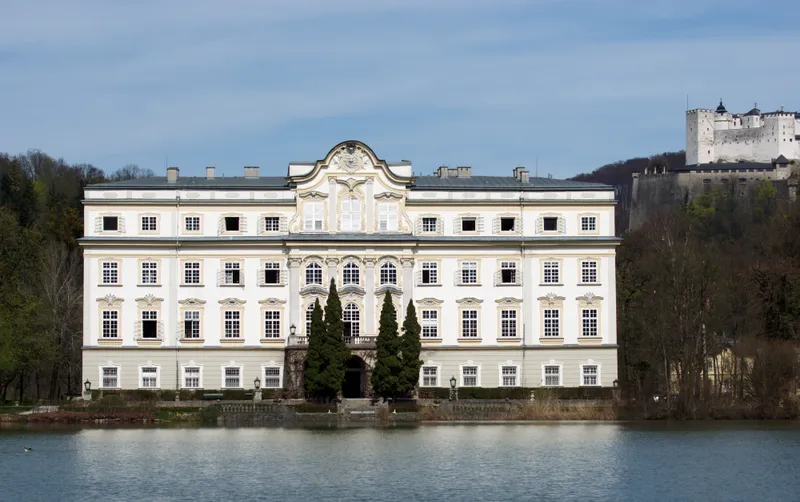
Further out and grander in mood, Leopoldskron in the green south-west trades walkability for serenity and that mirror-flat lake reflecting a rococo palace — the Sound of Music corner of the city. A base out here means relying on bus, bike or taxi for the centre, but rewards you with quiet, lake views and a romance the central hotels can't match. Reserve it for a special occasion rather than a sightseeing-heavy first visit.
- Nonntal: leafy and residential under the fortress, still walkable to the Old Town.
- Riedenburg: settled, good-value and a short walk or bus west of the centre.
- Leopoldskron: lakeside calm and romance, but out of the centre — best for special trips.
- Best for: return visitors, light sleepers and couples wanting quiet over convenience.

Festival and Christmas — when the calendar rewrites the rules
Two seasons change everything. During the Salzburg Festival in late July and August, the city fills with an opera-and-drama crowd, room rates climb steeply, and the best-placed hotels sell out months in advance — book early, and if you're attending performances, weigh how short you want the walk back to the Festspielhäuser after a late curtain. During Advent, the Christkindlmarkt on Domplatz and Residenzplatz draws weekend crowds and a second wave of demand; central hotels go first, and a December weekend booked late can be both expensive and scarce.
The practical move for both peaks is the same: decide your dates, then book as far ahead as you can, accepting that flexibility costs less the earlier you commit. Outside these windows — spring, early summer, autumn and the quieter winter weeks around January's Mozart Week — Salzburg is calmer and better value, and your choice of area can be led by taste rather than scarcity. Always confirm current rates and availability directly; we keep this guidance evergreen rather than quoting prices that move with the season.
- Festival (late July–August): peak rates, book months ahead, prize a short walk to the venues.
- Advent: weekend crowds and a second demand peak — central hotels sell first.
- Shoulder and winter weeks (incl. January's Mozart Week) are calmer and better value.
- Verify current prices and availability directly — seasons move them sharply.


Couples, families and budgets — quick matches
Beyond geography, it helps to match an area to the shape of your party. Couples on a romantic trip are best served by a boutique Old Town townhouse with a fortress-facing window, or — for an anniversary or honeymoon — the lakeside calm of Leopoldskron; both lean into atmosphere over square footage, which is exactly what makes them memorable. The Mirabell side is the gentle compromise if you want romance with comfort and an easy walk home after a candlelit dinner.
Families and multi-bag travellers should prize lifts, room to spread out and level streets, all of which the Neustadt around Mirabell and the station area supply more reliably than the cobbled Altstadt. Budget travellers consistently find the best value near the station, where a clean, well-placed room costs less and the bus or a short walk handles the rest. And because the whole centre is so compact, none of these choices strands you — a budget room by the station and a boutique suite off Getreidegasse can be the same quarter-hour from the cathedral.
- Couples: boutique Old Town townhouse or lakeside Leopoldskron; Mirabell for romance-plus-comfort.
- Families: the Neustadt or station area — lifts, bigger rooms, level streets.
- Budget: the station area gives the best value near transport.
- Compact city: most areas are a similar short walk from the cathedral square.

At a glance
A quick planning sketch to match an area to your trip. Salzburg's compactness means almost any central base works for a short visit; the differences below are about mood, comfort and logistics rather than real distance. Confirm current rates, availability and the season's demand directly before you book.
- Atmosphere, on the doorstep: the Altstadt and its Linzergasse edge — accept cobbles and steps.
- Comfortable and central: Mirabell and the Neustadt — flat walking, lifts, easy logistics.
- Practical and value-led: the station area — best for rail arrivals and lake day trips.
- Quiet: Nonntal and Riedenburg (still walkable) or lakeside Leopoldskron (out of centre).
- Two ticket products: the Salzburg Card (sightseeing) and the overnight Guest Mobility Ticket (transport) — don't confuse them.
- Festival and Advent: book months ahead; everything else, choose by taste.