Salzburg Etiquette and Customs
How things are done in Salzburg — restaurant timing, coffeehouse etiquette, tipping, greetings, church dress, concert behaviour and the quiet of a Salzburg Sunday.

- ✓Salzburg is courteous and a little formal: a spoken greeting on entering a shop or small restaurant, and a 'Grüß Gott' in return, goes a long way.
- ✓Tipping is modest and customary rather than a fixed percentage — Austrians typically round up or add a little, handed to the server, not left on the table.
- ✓The coffeehouse is an institution, not a fast stop: you're welcome to linger for an hour over one cup, and the water served alongside is part of the ritual.
- ✓Sundays and public holidays are genuinely quiet — most shops close, so plan food and essentials around it.
- ✓Churches are active places of worship as well as sights: dress modestly and keep voices low, especially during services.
At a glance
Salzburg runs on a gentle, old-fashioned courtesy that rewards a little effort. None of it is complicated, but knowing the rhythm — when to greet, when to tip, when the city simply stops for a Sunday — makes you feel far less like a tourist and far more like a welcome guest.
- Greetings: a spoken 'Grüß Gott' (or 'Servus' more casually) on entering small shops, bakeries and restaurants is normal and appreciated.
- Tipping: round up or add roughly five to ten percent for good service in restaurants; tell the server the total, don't just leave coins.
- Coffeehouses: linger as long as you like over one order; the glass of water is included and refillable on request.
- Sundays & holidays: most shops and supermarkets close — buy food and essentials the day before.
- Churches: modest dress, quiet voices, no flash during services; the cathedral and abbey churches are working places of worship.
- Verify: opening hours, holiday dates and any service charges shown on a bill change — check the day's specifics locally.
Greetings, formality and a little German
Austrians, and Salzburgers especially, are warm but a touch formal, and the small rituals matter. The regional greeting is 'Grüß Gott' — literally 'greet God', the everyday hello across Austria and Bavaria — and you'll hear it constantly. Say it when you walk into a bakery, a small shop or a family restaurant, and answer it when it's said to you. Among younger people and in casual settings 'Servus' does the same job. On leaving, a 'Wiedersehen' or 'Auf Wiederschauen' closes the loop. It feels ceremonious to visitors at first; locally it is simply good manners.
Almost everyone in tourism speaks excellent English, so you will never be stuck, but a few words of German are met with real warmth. 'Bitte' (please), 'Danke' (thank you), 'Entschuldigung' (excuse me) and a learned 'Grüß Gott' carry you a remarkably long way. Address older people and formal staff with 'Sie' rather than the familiar 'du' if you have any German at all. The tone to aim for is friendly but not over-familiar — Salzburg is a polite, composed city, and it returns the courtesy you offer.

How much should I tip in Salzburg?
Tipping in Austria is real but restrained — nothing like the obligatory percentages of North America. Good service in a restaurant is acknowledged by rounding the bill up or adding roughly five to ten percent; a few euros on a modest meal, a little more on a grand one. The mechanism matters as much as the amount: when the server tells you the total, you state the figure you want to pay including the tip ('Make it twenty-five, please') as you hand over cash or card, rather than leaving coins on the table after you go. Servers are paid a proper wage, so a tip is a thank-you, not their living — generous when service is good, and entirely fine to skip if it wasn't.
Elsewhere the gestures are smaller. In a café, round up or leave the small change. For a taxi, round up to the nearest sensible figure. Hotel porters and housekeeping appreciate a euro or two but expect nothing. At a bar you're not obliged to tip on a single beer, though rounding up is normal. If a service charge already appears on your bill, an extra tip is optional and modest. We don't quote fixed sums because expectations and prices shift — the principle is simply this: a little, in cash where you can, handed directly with thanks.

Coffeehouse and restaurant etiquette
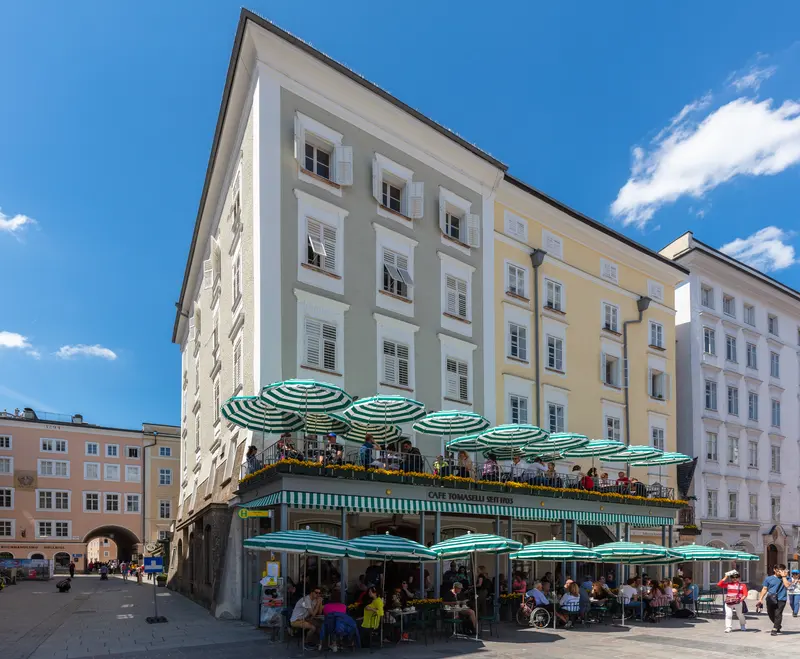
The Viennese-style coffeehouse, alive and well in Salzburg at places like Café Tomaselli, runs by its own gentle rules. A coffee is never just a coffee: order a Melange or an Einspänner and you've bought a seat for as long as you care to use it. Lingering over a single cup with a newspaper for an hour is not only tolerated, it is the entire point. The glass of water served alongside is included and a refill is yours for the asking. Don't expect to be rushed, and don't rush — the coffeehouse is a living room you happen not to own.
Restaurants are more relaxed than the formality of greetings might suggest, but a few habits help. You'll often seat yourself in casual places and wait to be seated in smarter ones; if a table has a 'Reserviert' card it's spoken for. Asking to share a long table in a busy beer hall is normal — a polite 'Ist hier frei?' ('Is this free?') is all it takes. Lunch tends to run earlier than in southern Europe and dinner is not late; kitchens in smaller places can close earlier than you'd expect, so don't leave dinner until nine and assume you'll be served. When you're ready to pay, catch the server's eye and ask for the bill — it won't be brought until you do.

Churches, concerts and dressing the part
Salzburg's great churches — the cathedral, St Peter's Abbey, the Franciscan Church, the Kollegienkirche — are working places of worship as much as masterpieces of Baroque, and a little reverence is expected. Dress modestly enough to cover shoulders and avoid very short shorts, keep your voice low, and step aside or stay out altogether if a mass or service is underway. Photography is usually fine but switch off the flash, and never photograph people at prayer. The same quiet respect applies at Nonnberg Abbey, a living convent rather than a museum.
Concerts are part of the city's lifeblood, from a fortress recital to a Marble Hall evening, and Salzburgers take them seriously. You won't need black tie for a standard chamber concert, but smart-casual is the floor and the Salzburg Festival's grander occasions draw genuinely elegant dress. Arrive in good time — latecomers are often held at the door until a break — silence your phone completely, hold applause until the end of a full work rather than between movements, and save photos for the foyer. The reward for these small disciplines is the thing you came for: Mozart's music, in his city, exactly as it should be heard.

The quiet Salzburg Sunday — and other customs
The single custom that catches visitors out most is the Austrian Sunday. By law and long habit, most shops and supermarkets close on Sundays and public holidays, and the city takes on a slow, churchgoing calm. Restaurants, cafés, bakeries (often open Sunday mornings), museums and the sights stay open, so you won't go hungry or bored — but if you need groceries, toiletries or a forgotten charger, buy them on Saturday. Station and airport shops are the usual exceptions for emergencies. Treat the quiet not as an inconvenience but as the city at its most local: a riverside walk, a long coffee, a church organ drifting out across a square.
A few last small things. Jaywalking is frowned upon — locals wait for the green man even on an empty street, and so should you. Recycling and tidiness are taken seriously; bins are sorted and litter is genuinely rare. Smoking is banned indoors in restaurants and bars. Cash is still widely used, especially for tips and in smaller places, though cards are accepted almost everywhere. And punctuality is quietly valued — for a tour, a concert or a dinner reservation, on time means on time. None of this is onerous. Salzburg simply rewards the traveller who slows down to its tempo, and gives back, in courtesy and calm, exactly what they bring.


Related guides

The Best Cafés in Salzburg
Salzburg's classic coffeehouses, cake stops, modern coffee bars and rainy-day refuges — plus how to order coffee the Austrian way and when to go.
Read guide
Salzburg Concerts Guide
Mozart dinners, fortress concerts, Mirabell concerts, cathedral music, Festival options and how to choose the right night for you.
Read guide
Salzburg Practical Travel Tips
The practical hub for Salzburg: arriving from the airport and station, getting around, the Salzburg Card versus the Guest Mobility Ticket, money, weather, safety, packing and first-timer advice.
Read guideMore in Practical Tips
6
Accessible Salzburg Guide
A clear-eyed accessibility guide to Salzburg — the cobblestone realities of the Old Town, where the level routes are, the funicular and step-free options, transport, sights and how to plan low-walking days.
Read guide
Best Time to Visit Salzburg
Month-by-month trade-offs for Salzburg — Festival summer, the Advent markets, the spring and autumn shoulders, the quiet deep-winter weeks, and how weather, crowds and prices move through the year.
Read guide
How to Get Around Salzburg
Walking, city buses, bikes, taxis, the fortress funicular, the Mönchsberg lift and day-trip transit — how to move around Salzburg, and when the Salzburg Card actually helps.
Read guide
Is Salzburg Safe?
An honest look at safety in Salzburg — a calm, low-crime city where the real risks are pickpockets in summer crowds, slippery cobbles and the mountains, not violent crime.
Read guide
Is the Salzburg Card Worth It?
When the Salzburg Card saves money and when it doesn't — how the 24, 48 and 72-hour options work, what's included, and how to do the quick maths before you buy.
Read guide
Luggage Storage in Salzburg
Where to leave your bags in Salzburg — the main station lockers, hotel storage, staffed left-luggage and bag-drop options near the Old Town, so you can explore unencumbered on arrival, departure or a layover.
Read guide