Nonnberg Abbey Guide
How to visit Nonnberg Abbey respectfully, with Sound of Music context, viewpoints over the Old Town and walking-route notes up the back of the fortress hill.

Photo: Uoaei1 / Wikimedia Commons · CC BY-SA 4.0
- ✓Stift Nonnberg is the oldest continuously operating women's convent north of the Alps, founded around 712–715 by Saint Rupert — over thirteen centuries of unbroken life.
- ✓Maria von Trapp really was a novice here before she married Georg von Trapp, so the convent is the one Sound of Music site that is genuinely the real place, not a film set.
- ✓The abbey church and its forecourt are open to visitors; the cloister and the nuns' living quarters are private and enclosed — this is a working contemplative community, not a museum.
- ✓The climb up the Nonnbergstiege from Kaigasse, or the gentler approach from the fortress, hands you one of the quietest fortress-and-Old-Town views in the city.
- ✓Go early or near dusk for stillness; the abbey sits just below Hohensalzburg, so it pairs naturally with a fortress visit.
At a glance
The quick orientation before you climb the steps — the steady facts, with a flag on what to verify on the day.
- What it is: Stift Nonnberg, a Benedictine convent founded around 712–715 — the oldest continuously running women's religious house north of the Alps.
- The Sound of Music link: the real Maria was a novice here, making it the one genuine, non-set film location; the gate and exterior feature in the 1965 film.
- What's open: the abbey church and its forecourt and viewpoint; the cloister, garden and nuns' quarters are private and enclosed.
- How to get up: the steep Nonnbergstiege steps from Kaigasse in the Old Town, or the gentler back path down from Hohensalzburg.
- The view: a quiet, lower-angle terrace over the cathedral domes, the river and the Kapuzinerberg opposite.
- Cost: no admission charge to the church; a small donation toward its upkeep is welcome.
- Verify before you go: the church's current opening hours and Mass times, which vary with the season and the liturgical calendar.
The convent on the shoulder of the fortress hill
Tucked into the eastern flank of the Festungsberg, just below Hohensalzburg, Nonnberg Abbey is the kind of place most visitors walk straight past on their way up to the fortress — and that is exactly why it stays so peaceful. Stift Nonnberg is a Benedictine convent founded around 712 to 715 by Saint Rupert, the same missionary bishop who effectively refounded Salzburg itself, and it has been home to a community of nuns ever since. That makes it, by most reckonings, the oldest women's religious house north of the Alps that has never closed: more than thirteen hundred years of prayer on one small terrace of rock.
What you actually see is gentler than the fortress looming above it. A pale Gothic church with a slender tower, a walled forecourt, a few worn flights of steps, and over the parapet a view that drops straight onto the domes and rooftops of the Old Town. There is no ticket booth, no audio guide, no gift shop the size of a supermarket. The reward here is atmosphere — the sense of standing somewhere that has quietly outlasted everything around it.
Because it is a working enclosed community, Nonnberg asks a little more of visitors than a typical sight. You come as a guest in someone's home and place of prayer, keep your voice down, and accept that most of the abbey is — rightly — not open to you. Read that as a feature, not a limitation: the restraint is what keeps the place feeling sacred rather than staged.
The real Maria — and the honest Sound of Music story
Nonnberg is one of the very few Sound of Music stops that is the genuine article. Maria Augusta Kutschera entered the convent here as a young novice in the 1920s, and it was from Nonnberg that she was sent to tutor a sick child in the household of the widower Georg von Trapp — the meeting that, eventually, became a marriage, a family choir and one of the most successful films ever made. The 1965 film used the abbey's exterior and its great wooden gate for several scenes, including the nuns' 'Maria' number and the family's flight.
It helps to be clear about what the film invented and what it didn't. The von Trapps did not clamber over the Alps to freedom from Salzburg — geographically that would have walked them deeper into Germany — they left quietly by train. And the interior shots of the convent were filmed on a Hollywood sound stage, not inside Nonnberg's enclosure, which no camera crew was ever going to enter. But the place where a real Maria really was a real novice? That is here, on this terrace, and standing at the gate is a more honest brush with the story than any staged location elsewhere in the city.
If the Sound of Music is the thread pulling you up the hill, fold Nonnberg into the wider locations route rather than treating it as a standalone pilgrimage. It is the quiet, true bookend to the showier garden and palace stops down in the city.
How to walk up — and the view when you arrive
There are two unhurried ways up. The classic approach is the Nonnbergstiege, a stepped lane that climbs from Kaigasse at the eastern edge of the Old Town; it is short but properly steep, a few minutes of honest effort that delivers you straight to the abbey forecourt. The gentler alternative is to come at it from above: if you are already up at Hohensalzburg, a signed path drops down the back of the fortress hill to the convent, so you can ride or walk up to the castle and freewheel down to Nonnberg on the way back.
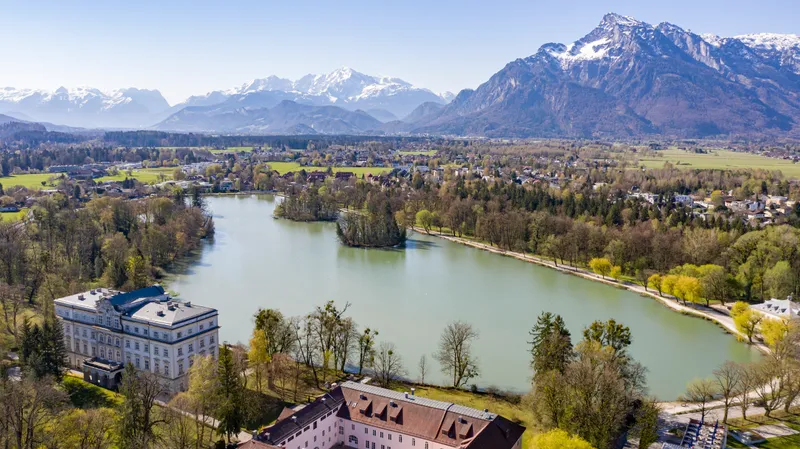
Either way, the payoff is the same. From the parapet outside the church the city falls away beneath you — cathedral domes, the green copper roofs, the Salzach threading between the two banks, and the wooded hump of the Kapuzinerberg opposite. It is a different, lower, more intimate angle than the grand panorama from the fortress, and because so few people bother with the detour, you often have it to yourself. Early morning light and the last half-hour before sunset are the magic windows.
Wear shoes you trust on worn stone, and remember that this is a hill walk in miniature rather than a stroll. In wet or icy weather the steps can be slick. Those who would rather not tackle the stairs can take the fortress funicular up and walk down the back path, which is the easiest line of all.

Visiting respectfully: what is open, and how to behave
The abbey church and its forecourt are the parts open to visitors; the cloister, garden and the nuns' quarters are enclosed and private. Inside the church, look for the Gothic winged altar and the faded medieval frescoes in the Romanesque niches beneath the nuns' choir — among the older wall paintings to survive in the city. Mass and the sung Liturgy of the Hours are public, and hearing the community chant is the most moving way to experience the place; if you attend, you come as a worshipper or a silent guest, not a spectator.
Keep it simple and considerate. Dress as you would for any church, silence your phone, don't use flash, and don't try to photograph the nuns. Opening times for the church can be limited and may change with the liturgical calendar and the seasons, so check current hours with the abbey before a special trip rather than relying on any fixed timetable — we'd always say verify locally. There is no admission charge to enter the church, though a small donation toward its upkeep is a gracious thing to leave.
If you can, time your visit around the sung Liturgy of the Hours or a Mass. The community keeps the ancient rhythm of monastic prayer, and to stand in the cool Gothic church while women's voices rise in chant — as they have on this spot for thirteen centuries — is a genuinely affecting experience, and free. Check current service times with the abbey, dress and behave as you would in any place of worship, and remember you are a guest at someone's prayer, not an audience at a performance.
How does it fit a day? Most people fold Nonnberg into a fortress visit, since the two share the same hill: ride the funicular up to Hohensalzburg, see the castle, then walk down the back path to the abbey and continue on the Nonnbergstiege into the Old Town — a satisfying, mostly downhill loop that takes in the city's two great hilltop landmarks in one go. Sound of Music pilgrims can slot it into the wider locations route; couples and quiet-seekers can treat it as a hushed counterpoint to the busier squares. Either way it asks little time and gives a great deal of atmosphere.
Treated this way, Nonnberg becomes one of the most quietly rewarding half-hours in Salzburg — a working thread of living history, a true Sound of Music location and a private balcony over the Old Town, all reached by one short flight of steps.


Related guides
Sound of Music Filming Locations
An honest, location-by-location guide to where The Sound of Music was really filmed in and around Salzburg — Mirabell, Nonnberg, Leopoldskron, Hellbrunn, Residenzplatz and Mondsee — and which stops are walkable versus a drive.
Read guide
Best Viewpoints in Salzburg
Fortress, Mönchsberg, Kapuzinerberg, Humboldtterrasse, Untersberg, rooftops and river views ranked by effort.
Read guide
Self-Guided Salzburg Old Town Walk
A step-by-step self-guided walking route linking Mirabell, the river views, Getreidegasse, the cathedral, St. Peter's and the climb to the fortress — done at an easy half-day pace.
Read guideMore in Things to Do
6
Best Museums in Salzburg
Choose Salzburg museums by interest, weather, Mozart focus, family fit and Salzburg Card value.
Read guide
Best Photo Spots in Salzburg
Fortress views, Mirabell, Old Town lanes, river bridges, Mönchsberg, blue hour and Christmas lights.
Read guide
Best Salzburg Tours
When to book walking, Mozart, Sound of Music, food, fortress, bike and day-trip tours — and when to skip a tour and just wander.
Read guide
Best Things to Do in Salzburg
A ranked first-trip shortlist of the best things to do in Salzburg — what to book, what is free, and how to group the city so you never backtrack.
Read guide
Best Walking Tours in Salzburg
Which Salzburg walking tour fits your time, interests, mobility, music focus and budget — from free group walks to private guides.
Read guide
Day Trips from Salzburg
The hub for the best day trips from Salzburg — Hallstatt, the Salzkammergut lakes, the Eagle's Nest and Berchtesgaden, Königssee, Werfen's ice caves and a hop into Munich.
Read guide